
Cheerful Evil
Being polite, being nice, and being good are three different things

A sufficient amount of stupidity is indistinguishable from malice. - Karel Antonovič Janáček
If you’ve studied enough history, you have probably noticed that the greatest evils have been carried out by nice, polite, agreeable people who genuinely believed that they were doing good. No amount of pleading or attempts at reasoning with these people would ever change their minds, because they were led to believe that anyone attempting to draw them away from their path was deceiving them. “Reason and logic are lies from the pit of [insert object of ultimate ire here1],” they were told. In other words, they were brainwashed. The greatest trick the Devil ever played wasn’t to convince man that he didn’t exist, but that he was God, and that God was the Lord of Lies.
I had planned to write this piece for a while, but there was another angle that I decided to add following an odd exchange with Alexander Semenyuk. He believes that everyone has a moral compass, and anyone can know right from wrong if they really tried. I didn’t tell him what I really thought at the time, but those of you who have been following me for any amount of time are aware that I don’t subscribe to that idea for quite a few reasons, one of them rooted in theology, oddly enough. To explain why, we must first re-visit the Golden Rule of Christianity: do unto others as you would have others do unto you. I try to live by this principle, and I’m not even a Christian (but most of my friends are, and I find Christian philosophy to be quite valuable at times). All I want is to be left alone, and so I in turn prefer to leave others alone. The reason I spend so much bloody time writing about political theory and other social phenomena, rather than tending to my works of fiction, is precisely because people don’t leave each other alone, and that not only bothers me, but in plenty of instances, directly affects me. My various experiences in life have convinced me that some people are either incapable of understanding the Golden Rule, or deliberately weaponise it in order to fulfil their own selfish desires.
Some of you will probably think this is cringey as hell, but I find SpongeBob Sociology to be particularly valuable as an illustrative tool in this instance. I’m sure UnLambed Zoomer will appreciate it, though I actually got the idea from Michael Stefan, and ran with it…
Silliness

There is a time and a place for everything, but some people seem to be stuck in one “mode” for lack of a better word. They act as if they are pre-programmed, and will just keep doing the same thing no matter how much it doesn’t work, no matter how many people point out that it doesn’t work, no matter how many times they see for themselves that it doesn…
…twice.
The Bore

As a direct follow-up to my last article, today I’m going to rant about another type of personality I can’t stand. Now, you might think of the old meme, “I hate lazy people,” followed by “why, we didn’t even do anything.” It’s the same with boring people. In both cases, they can make nuisances of themselves by injecting their behaviour into areas whe…
In case you don’t feel like clicking off, the short version is that I am a lot like Squidward, and I used to have a coworker who was exactly like SpongeBob. I also briefly mentioned something I like to call the “Evil SpongeBob Archetype.” I’ll get into that in a bit, but in the second article, I posited that perhaps the insufferable busybody does understand the Golden Rule, and the reason he’s constantly judging everyone is precisely because he himself wants to be judged. That is definitely true in a lot of cases, as some people crave external validation. The same is true of some people who fit the SpongeBob archetype. SpongeBob is constantly playing with Squidward precisely because he wants to be played with in turn. Squidward, however, does not like this behaviour. He has no desire to play with SpongeBob, he finds SpongeBob annoying, and in order to teach him a lesson, will do something that he knows SpongeBob doesn’t like. SpongeBob never learns, either out of selfishness, stupidity, or some combination of both. Without being able to read his mind, it is impossible to say which, for certain. In the case of the cartoon character, we know his motivation: he’s a well-meaning idiot. Real-world examples, on the other hand, I’m not so sure about.
The Evil SpongeBob refuses to leave Squidward alone because he thinks there is something fundamentally wrong with the Squidward archetype. The Evil SpongeBob overlaps quite a bit with the busybody in this regard, aggressively refusing to understand that people have different innate preferences. Squidward wants to be left alone. This, to the Evil SpongeBob, is wrong, and Squidward must be corrected. People who fit this pattern are not hard to find, incidentally. One of my favourite proverbial punching bags, at least before he disabled comments on his website like the intellectual coward that he is, was Andrew Zehner, the Congenial Iconoclast, or as I call him, the Civic Ignoramus. He’s a cheerfully idiotic statist busybody who thinks that no amount of voluntary charity is enough, instead that community service should be mandated by the state. Why? Because John Stuart Mill said so, apparently.2 In any case, considering that he has expressed approval for assassinating politicians that he doesn’t like (e.g. Trump and Hitler, because he’s as blue-pilled as they come), there is no way his motivations are pure. He’s certainly no Christian, despite having used Christian morality in order to support his arguments; rather, he is one of the many incarnations of this meme:
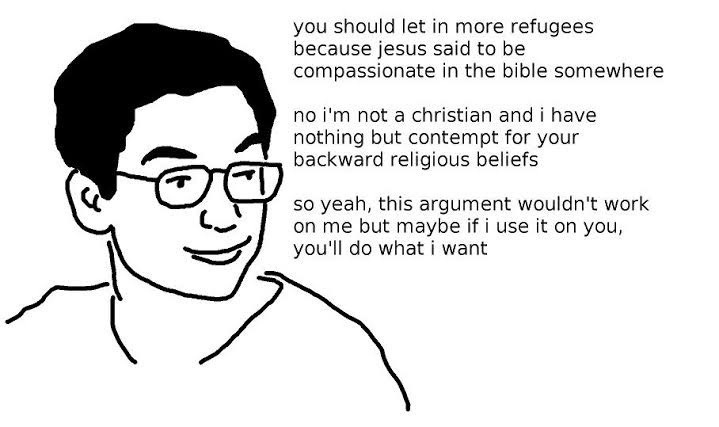
Oh, by the way, spare me your opinions about immigration, not because I probably disagree with them, but because they are not relevant here. Save it for when I kick my own camp in the bum with my article on realpolitik. Anyway, the Civic Ignoramus believes there to be something morally wrong with wanting to be left alone, as though introversion were some kind of mental illness or worse. He is convinced that people like me are misguided at best and evil at worst, and he feels compelled to increase the power of the state in order to “correct” my preferences and even my very nature. See, this is why we know blank slate theory is nonsense; even the people who push it the hardest instinctively understand that people are innately different, and that natural hierarchies exist, which is why they always resort to coercion in order to produce equality. Just as an inferior idea can be expressed in the terms of a superior idea, but not the other way round, a superior mind can understand the workings of an inferior mind, but not the other way round. Introverts generally have superior minds to extroverts, and this is the root of every Squidward’s frustration with the SpongeBobs of the world, especially the Evil SpongeBobs. SpongeBob is dumb, so very dumb, but at least he’s trying. Evil SpongeBob won’t even try, he insists that he is already right, that his shallow understanding is the highest wisdom, and that his demonstrably incorrect beliefs are the absolute truth. If this is sounding rather cultish, that’s because it is. In one episode, SpongeBob was a cultist, and blindly obeyed everything that his “magic conch” pull-string toy told him, up to and including not allowing Squidward to have any food. If SpongeBob were always like that, he would be an evil character.
But Sasha, not everyone who joins a cult is evil! This whole time you’ve been saying that evil is a choice, not an outcome!
It’s both, really. The reason that I opened with the quote I did is simple: there is no way to know if a deleterious condition is the result of evil or stupidity without knowing the motive behind it. In the case of fictional characters, their inner monologue tells us what their motive is. In the real world, all we have to go by are actions, consequences, and patterns. Words aren’t worth dirt. If I feed someone and they immediately die, have I done evil? If there is nothing wrong with the food, I haven’t, unless the person was deathly allergic to one of the ingredients and I knew ahead of time. On the flip side, if I put poison in the food and the person doesn’t die because of an immunity that I didn’t know about, I’ve still done evil, I just didn’t produce an observable evil. Think of this as the moral version of the “if a tree falls in a forest” question.
Scaling up this dilemma, if a politician implements an agricultural policy that is extremely popular with the general public but which every farmer said was dumb, and then there is a massive food shortage as a direct result, it is permissible to give said politician the benefit of the doubt initially.3 However, if he doesn’t immediately reverse said policy upon realising that it caused the problem, then it’s safe to say that he’s evil. The same goes for anyone who supported said policy, and no amount of congeniality will ever convince me otherwise. Yes, a lot of politicians are mentally retarded, and there is no greater argument against democracy than a conversation with the average voter, but stupid and evil aren’t mutually exclusive, and at some point, reason, understanding, and forgiveness are all off the table. Some people respond only to force, and thus to prevent them from causing disaster, intentionally or otherwise, they must be restrained, behind bars if necessary. Remember friends, SpongeBob is mentally incapable of understanding boundaries to the point where will happily barge into Squidward’s house whenever he wants, and he won’t leave unless Squidward literally throws him out. People like that are real, and are disturbingly numerous.
So, what do we do with these people? Simple: physical removal. Tentacle Acres doesn’t allow sponges or starfish to even enter. But in all seriousness, while I have a certain morbid admiration for people who are willing to die on the hill (sometimes quite literally) of saving these people, I sincerely believe that they are wasting their time. After all, the cheerfully evil are convinced that they are trying to save you via the gospel of their own false god. Forget saving someone who doesn’t want to be saved, you cannot save someone who is convinced that you are the one who needs saving. Besides, there is this weird property about the mentally deficient that you are probably unaware of unless you’re an occultist, given that it is an idea present in some form in Hermeticism, Gnosticism, Judaism, and even certain circles within Christianity, some highly intellectual, others less so (looking at you, Jehovah’s Witnesses). Here is an excerpt from Alchemy and Eschatology, Part 1: The Soul.
The “creatures of pure flesh” are called hylics, who possess neither soul nor spirit, and therefore are little more than beasts. Others, the psychics, possess a soul but no spirit, and thus have potential to become enlightened. Those who have received the gift of the spirit are enlightened, the pneumatics, and it is their sacred duty to share this gift will all those who possess the capacity for it.
…alternate version is the “Bank of Souls” theory. According to this theory, the fruit of the Tree of Life is human souls, but the tree doesn’t produce fruit consistently, so children conceived during lean times might not receive a soul. Some people have used the hylic explanation for the NPC phenomenon in the modern day, after all, there is simply no way that the Tree of Life can produce enough souls for all of humanity, right? Mind you, there is an anti-Gnostic angle to this theory as well, because Christian theologians who entertain the Bank of Souls theory maintain that hylics are not the spawn of the devil, but are instead part of God’s grand design, a test for those who do possess a soul, and thus the potential for growth.
“Be nice to stupid people, they can’t help it,” I was always told. Bollocks! In a good number of instances, it’s a trick; evil people play dumb so that people are more likely to forgive them, and they can get away with leaving a trail of destruction in their wake. Worse, so many people fall for it, making it easy to demonise people who can see through the deception. Hanlon’s Razor is dead, long live Bezmenov’s Razor!

Speaking of demonisation, let’s assume that daemons are real for this next bit, because even if you’re an atheist, this analogy should still get the point across. Daemons are disembodied spirits representing an idea. Let them in, and they will take over your life, like an addiction. We all have our own personal daemons, some of them sins, others more innocuous. Some people do this unintentionally, because they were told “daemons aren’t real, they can’t hurt you.” Others do this rather deliberately, “selling their soul” for power. With this in mind, consider the Bank of Souls theory again: perhaps some people never had a human soul, and are thus perfect vessels to be possessed by a daemon. A lesser daemon, mind you, because with nothing to trade, such a person will receive no great gift. All power demands sacrifice. This gives a whole new dimension to “if you don’t stand for something, you’ll fall for anything,” dunnit? Incidentally, this is why atheist libertarians are so heavily invested in studying and promoting universal ethics, because a freer future requires people to act with principles. Where those principles come from is, in the cosmic sense, immaterial, though the fact that many libertarian principles overlap heavily with the classical religions has not gone unnoticed.
One final thing before I let ye lovelies go: at the very beginning, I mentioned that the Devil has tricked people into thinking that he is God. Daemons sometimes try to pass themselves off as angels,4 which not only means that people listen to daemons, but will happily kill angels when they get the chance. Perhaps you’ve heard that the 1% rule, 90% are asleep, and 4% try to keep the other 5% from waking the 90%. Members of the 4% frequently disguise themselves as members of the 5%. Keep this in mind the next time you hear someone say that autistic people are antisocial and therefore evil, or that a genuinely autistic person is evil. Autists have a natural immunity to propaganda, which makes us natural enemies of sociopaths. Sociopaths, in turn, like to wear autism as a skinsuit. Keep this in mind, and remember also, Autism Speaks does not speak for us. If you’ve made it this far, I trust you can pick up what I’m putting down here. Na shledanou.
Hell, capitalism, white supremacy, take your pick.
No source was ever provided for this assertion, so I have no idea where Mill said this. In any case, one should note that every single person who has proposed mandating European-style national service in America has been a big fan of Mill.
I wouldn’t, but that’s because no-one in politics today has an excuse for not knowing about the engineered famines of the 20th century.
There is a common misconception that angels are incorporeal, which is not a descriptor ever applied to them in scriptures. Daemons are incorporeal entities, whereas angels are physical beings.
Very detailed, I like it, great article, lots of work! These topics are great. I think demonic possessions are especially big subject. I have never written about it. Maybe one day!
Lengthy essay that deserves a couple of separate comments, the quote for "sermon":
> " 'Reason and logic are lies from the pit of [insert object of ultimate ire here1],' they say."
Reminds me of something from Martin Luther (not King which is another story): "That whore Reason".
Though I'm also reminded of "Even the Devil can quote scripture." Presumably she, he, or it -- so speak -- can also reason ...
Kind of the nature of the beast -- the viability of the conclusions of reason depend very much on that of the premises. Which are often more matters of faith than of fact, than of "truth". As Pontius Pilate is reputed to have asked, "What is truth?"
Now, where is my Gideon's Bible? ... 😉🙂